

In the world of high-stakes manufacturing, the phrase “close enough” is a precursor to disaster. For engineers in the medical, aerospace, and electronics sectors, a deviation of a few thousandths of an inch is not just a measurement error. It is a functional failure that can result in scrapped assemblies, compromised safety, and significant financial loss. When you are designing components for a surgical instrument or a high-frequency aerospace connector, the margin for error effectively disappears.
When traditional machining methods reach their physical limits, particularly with long, slender, or intricate components, a different approach is required. This is where CNC Swiss turning becomes the essential solution for projects that demand absolute stability and repeatable precision. At Lakeview Precision, we understand that these parts are often the “heart” of your assembly, and we treat their production with a level of detail that borders on the obsessive.
The Physics of Failure in Traditional Machining
Many procurement managers encounter a recurring problem: a vendor accepts a job for a complex part, but the final yield is plagued by inconsistencies. Often, the root cause is not the lack of skill of the operator but the inherent physical limitations of the equipment being used. In conventional lathes, the workpiece is held in a chuck or collet and extended into the work area. As the cutting tool applies pressure to the material, the part can deflect or vibrate.
This issue is amplified when the length-to-diameter ratio is high. Imagine trying to sharpen a very long, thin pencil while holding only the very back of it. The tip will wobble and bend as soon as the sharpener touches it. This is exactly what happens inside a standard CNC lathe. This deflection is the enemy of tight tolerance work. Even the most experienced machinist cannot overcome the laws of physics if the material is physically moving away from the tool during the cut.
This physical instability results in “chatter” marks, tapered diameters, and dimensions that drift out of spec as the tool moves further from the support of the spindle. For a precision machining company, relying on traditional turning for these geometries is a gamble that usually results in high scrap rates and delayed timelines.
How the Swiss Process Eliminates Deflection
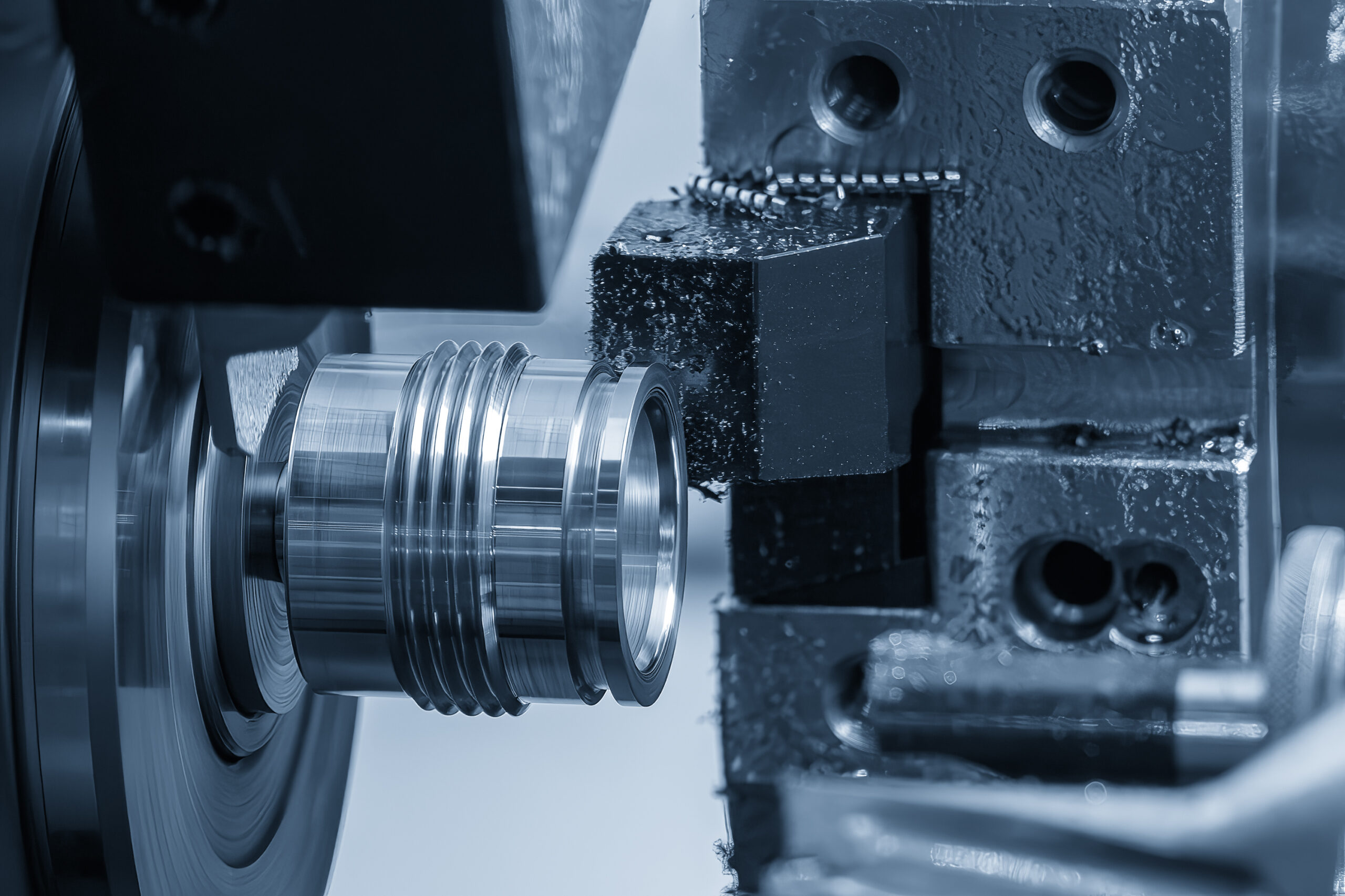
The fundamental difference in CNC Swiss turning lies in the use of a guide bushing. In a Swiss-style machine, the material is supported right at the point of the cutting action. Instead of the tool moving to the part, the headstock moves the material through the guide bushing toward the stationary tool. This ensures that the distance between the support and the tool remains constant and minimal at all times.
By providing support mere fractions of an inch from the cutting edge, the Swiss process eliminates the vibration and deflection issues found in standard turning. This allows for the production of incredibly small, long, and complex parts with a level of accuracy that other shops simply cannot replicate. We are obsessed with these technical details because we know your project depends on the structural integrity of every single micron.
The “Zero-Failure” Mandate for High-Precision Industries
For a Chicago precision manufacturing partner, being “invested” means understanding the end-use of every component. We recognize that our parts are often destined for environments where failure is not an option. In the medical field, a bone screw or a valve component must be perfect every single time. There is no room for a “percentage of error” when human health or mission-critical aerospace systems are on the line.
At Lakeview Precision, we position ourselves as an investment partner rather than a transactional vendor. When other shops fail on quality or communication, we step in to rescue the project. We often see “rescue” projects where a previous shop attempted to use standard equipment for a Swiss-required part, resulting in a 30% scrap rate. Our zero-failure promise is backed by a culture that is relentless in its pursuit of perfection. We do not just “run parts”: we engineer processes that guarantee results from the first piece to the ten-thousandth.
Tight Tolerance as a Standard, Not an Option
Many shops claim to offer precision machining services, but few are equipped to handle tolerances down to +/- 0.0002 inches consistently across a full production run. Achieving this requires more than just high-end machinery: it requires an environment of total control. This includes climate-controlled shop floors to prevent thermal expansion of the metal and rigorous quality control protocols that are integrated into the machine cycle itself.
Our experienced team understands how different materials react to heat and pressure. Whether we are working with stainless steel, titanium, or specialized plastics, we adapt our speeds, feeds, and tooling to the specific “personality” of the material. We leverage our expertise in Swiss turning to handle diameters up to 1-7/16 inches (38mm) and 144″ in length, as long as the part does not exceed roughly 9/16″ in diameter. This versatility makes us a preferred partner for engineers who are tired of being told their designs are “too difficult” to manufacture. If the geometry is physically possible, we will find the most efficient and reliable way to produce it.
The “Rescue” Scenario: Why Projects Migrate to Lakeview
A common scenario in the Midwest manufacturing corridor involves a procurement manager who is forced to find a new shop mid-project. Usually, the initial “low-cost” vendor over-promised on their capability. Perhaps they could make five good parts for the prototype phase, but once the order moved to a mid-volume run, their process fell apart. The tolerances began to drift, the surface finish degraded, and the delivery dates began to slip.
This is the moment where Lakeview Precision excels. We specialize in these high-complexity transitions. We don’t just look at your print: we look at your assembly requirements and your long-term goals. We often find that by applying CNC Swiss turning to a part previously made on a conventional lathe, we can actually reduce the total cost of ownership by eliminating secondary operations and reducing the assembly failure rate.
Beyond Machining: The Value of an Invested Partner
Choosing a manufacturing partner involves more than just verifying their equipment list. It involves finding a team that is adaptable and ready to scale with your needs. Many procurement managers face “rescue” scenarios not just because of technical failures, but because of a lack of reliability. If a vendor fails to communicate a delay or lacks the capacity for proper inventory planning, your entire production line can ground to a halt.
Lakeview Precision is a woman-owned business built on transparency and reliability. We believe that initial communication is just as important as the final delivery. By integrating deeply with our clients’ supply chains, we ensure that parts are ready when they are needed. We offer inventory planning services that help our partners manage their cash flow while ensuring they never face a “stock-out” situation.
Technical Consulting and DFM
Our involvement often starts long before the machines begin to spin. As part of our commitment to being an “Invested Partner,” we offer Design for Manufacturing (DFM) consulting. Our engineers work with your R&D team to identify areas where a design can be optimized for the Swiss turning process. Sometimes, a tiny change in a fillet radius or a shoulder specification can lead to a significant increase in production speed and a decrease in tool wear, without compromising the part’s function.
This collaborative approach is why we have long-standing relationships with some of the most demanding engineering firms in the country. They don’t just see us as a shop: they see us as an extension of their own engineering department.
Does your current vendor struggle with tight tolerances or complex Swiss-turned parts?
Don’t wait for a total production failure to make the switch. Contact the experts at Lakeview Precision today to discuss how our “Zero-Failure” approach can protect your supply chain and improve your product’s performance.
Call: (847) 742-7170 or Email: sales@lakeviewprecision.com
Key Takeaways
- Precision Support: CNC Swiss turning uses a guide bushing to support the material at the point of cut, eliminating deflection and vibration.
- Complex Geometry: This process is the gold standard for long, thin, or high-complexity parts that traditional lathes cannot handle.
- Zero-Failure Culture: Lakeview Precision focuses on high-stakes components where the “close enough” mentality is unacceptable.
- Strategic Partnership: We offer more than machining: we provide inventory planning, DFM consulting, and a “rescue” capability for failing projects.
- Technical Limits: We handle diameters up to 1-7/16” and lengths up to 144”, with tolerances as tight as +/- 0.0002”.