


In the world of high-stakes manufacturing, the difference between a successful product launch and a costly supply chain failure often comes down to a few microns. For engineers and procurement managers in the medical, aerospace, and electronics sectors, “good enough” machining is a liability. You need a partner who understands that complex geometries and tight tolerance requirements are not just challenges to be met, but standards to be exceeded.
Many shops claim to offer comprehensive precision machining services, yet they often struggle when a part’s length-to-diameter ratio exceeds the capabilities of a traditional CNC lathe. This is where standard machining fails and where Lakeview Precision steps in. By utilizing advanced CNC Swiss turning technology, we provide an investment in quality that eliminates the “rescue” scenarios common with less specialized vendors.
The Structural Flaw in Traditional Machining
The fundamental problem with standard CNC turning centers is the lack of support for the workpiece. In a traditional lathe, the material is held in a collet or chuck and extends into the machine. As the cutting tool applies pressure to the part, the material can deflect or vibrate, especially if the part is long and thin.
This deflection is the enemy of precision. It leads to tapered cuts, poor surface finishes, and dimensions that drift outside of the required specifications. When you are dealing with critical components for medical devices or aerospace sensors, even a microscopic amount of tremor can result in a rejected batch. For the procurement manager, this means missed deadlines and a frantic search for a new vendor who can actually execute the design.
How Swiss Turning Solves the Deflection Issue
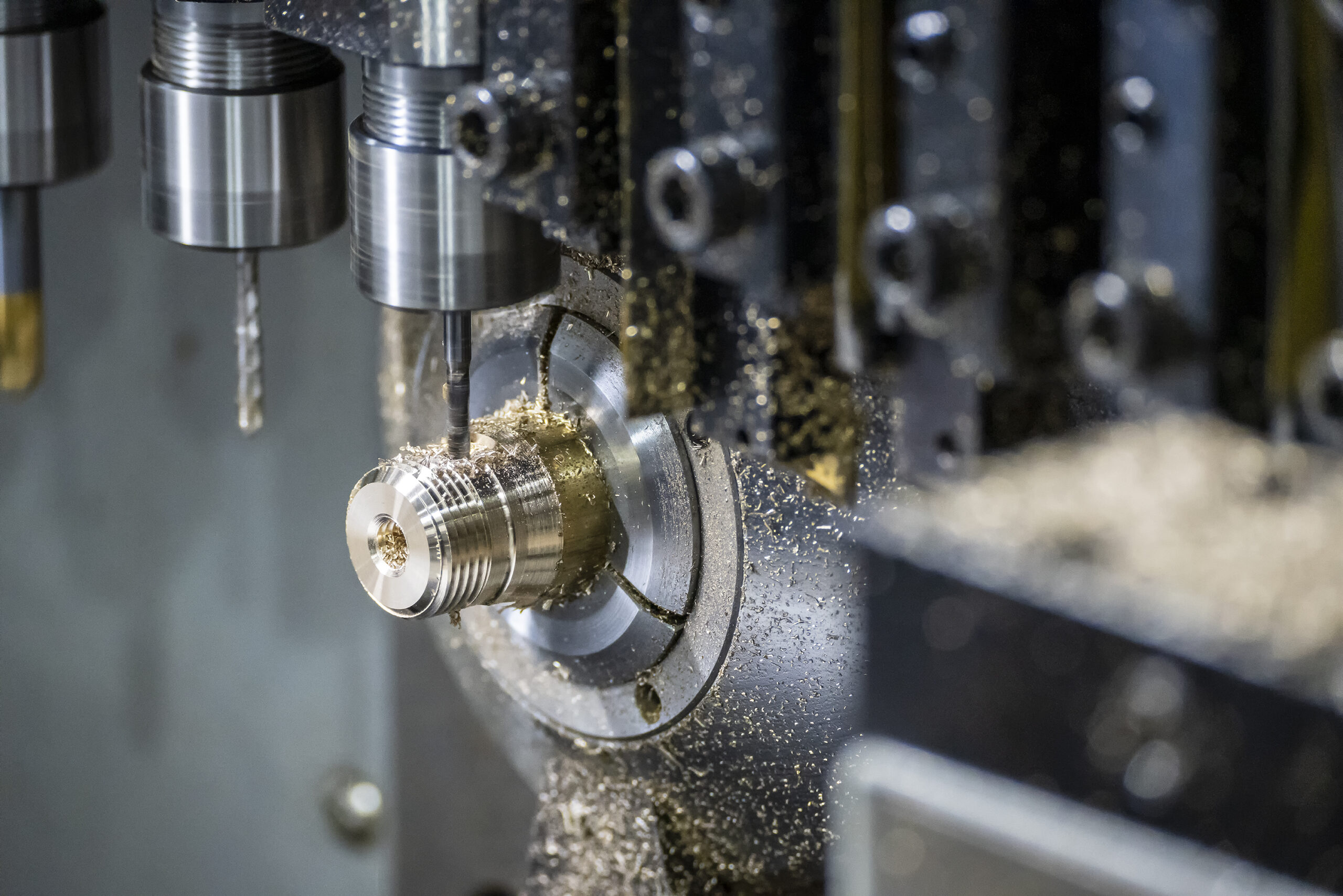
The CNC Swiss turning process utilizes a sliding headstock and a guide bushing. Instead of the tool moving to the part, the part moves through the guide bushing to the tool. This means the cutting action always takes place within a few millimeters of the support point.
Because the material is supported right where the work is being done, deflection is virtually eliminated. This allows for the production of incredibly long, thin, and intricate parts that would be impossible to manufacture on a standard lathe. We are obsessed with this level of stability because it is the only way to guarantee a “Zero-Failure” outcome for our partners.
Beyond the Basics: The Multi-Axis Advantage
Standard machining often requires multiple setups to complete a complex part. Every time a human hand touches a part to move it from one machine to another, the risk of error increases exponentially. Misalignment, concentricity issues, and simple handling damage can ruin an entire production run.
Lakeview Precision utilizes multi-axis Swiss machines that can perform turning, milling, drilling, and cross-tapping in a single operation. This “done-in-one” philosophy is a core component of our CNC Swiss turning department. By completing the part in one setup, we maintain the geometric relationships between features with absolute certainty.
Eliminating Cumulative Error
In traditional manufacturing, “tolerance stack-up” is a constant threat. If Operation A has a slight offset, and Operation B is performed on a different machine, those errors compound. By the time the part reaches final inspection, it may technically meet individual dimensions but fail the functional assembly test.
Our investment in high-end Swiss technology allows us to maintain a single point of reference for the entire machining process. This ensures that every hole, slot, and thread is perfectly oriented to the primary axis of the part. This level of reliability is why we are often called upon to “rescue” projects that other shops have fumbled.
Why Materials Matter in Precision Machining
The choice of material significantly impacts how a part behaves during the machining process. Common materials like stainless steel, titanium, and specialized plastics all have different thermal expansion rates and “memory.” A standard shop might treat every metal the same, but an experienced partner knows better.
At Lakeview Precision, we are relentless in our study of material science. We understand how different alloys react to the high speeds and pressures of Swiss machining. Whether we are working with 303 Stainless or high-temp aerospace alloys, we adjust our tooling and coolant strategies to ensure the material remains stable.
Managing Heat and Friction
Heat is the silent killer of tight tolerance parts. In a traditional machining environment, excessive heat can cause the material to expand during the cut. Once the part cools down, the dimensions shrink, often falling out of spec.
Our Swiss machines are designed with high-pressure coolant systems, and coolant chilling systems to ensure a steady operating temperature. This allows us to maintain a consistent environment inside the machine. By controlling the temperature at the point of the cut, we ensure that the part you designed on your screen is exactly the part that arrives at your facility.
The Financial Reality of the “Investment Partner”
Procurement managers are often pressured to look at the bottom line, but in precision manufacturing, the lowest quote is frequently the most expensive choice. If a vendor delivers 5,000 parts that are slightly out of spec, the cost is not just the lost material. It is the cost of downtime, the cost of re-engineering, and the cost of your reputation with your own customers.
We position ourselves as an Investment Partner because we understand the long-term stakes. When you work with a woman-owned, ISO-compliant shop like Lakeview, you are buying peace of mind. Our obsessive attention to detail from the initial DFM (Design for Manufacturing) review to the final delivery means you won’t have to deal with the “rescue” costs associated with transactional vendors.
Strategic Inventory and Reliability
Being a partner also means looking at the broader supply chain. We don’t just want to finish one job; we want to ensure your production line never stops. This is why we emphasize reliability and inventory planning as part of our core operations.
When a design engineer works with us during the R&D phase, we provide technical consulting to help them design better, more manufacturable parts. This collaboration early in the process prevents manufacturing bottlenecks later. It is a proactive approach that transactional shops simply do not offer.
Summary: The Lakeview Difference
Choosing a machining partner is a decision that impacts every stage of your product’s lifecycle. While standard shops are fine for simple, high-volume hardware, they lack the specialized equipment and obsessive culture required for tight tolerance components.
Lakeview Precision was built to handle the “impossible” parts. We thrive on the complexity that makes other shops walk away. Our team is invested in your success, offering an adaptable and experienced approach to every project we touch.
Key Takeaways
- Eliminate Deflection: Swiss turning provides support at the point of the cut, allowing for long, thin parts with zero vibration.
- Done-in-One Efficiency: Multi-axis machines complete complex parts in a single setup, eliminating cumulative errors from multiple hand-offs.
- Material Expertise: Understanding material behavior under heat and pressure is critical for maintaining tolerances in aerospace and medical alloys.
- Risk Mitigation: Partnering with an “Investment” shop prevents the high costs of quality failures and late deliveries found at lower-tier vendors.
- Strategic Collaboration: Early-stage DFM consulting ensures your designs are optimized for both quality and manufacturing efficiency.
Ready to stop gambling on your precision components?
Whether you are in the middle of a design cycle or need to rescue a project from a failing vendor, Lakeview Precision is ready to step in. We are obsessed with the details, so you don’t have to be. Contact Lakeview Precision today: Call us at 847-742-7170 or visit our Contact Page to start your project.